
If you have been reading this newsletter for a while, you may have noticed that I rarely leave sacred Sales ideas untouched.
Not because I enjoy being contrarian. (Although I admit: I do enjoy questioning things that have become unquestionable.)
Because in complex B2B, “best practices” often survive long after the conditions that made them true.
Most of my perspective comes from selling and leading across different countries, industries, and buying cultures.
Not as a former Rep turned commentator.
As someone still in the arena.
And often in roles where there was no playbook - I was hired to launch something new, explore a new market, or build a motion from scratch.
In those roles, I was not only evangelizing to customers. I was also translating reality back into my own organization - and getting internal stakeholders to move with me.
When there is no blueprint, you learn quickly: you cannot outsource judgment.
This time, my target is Sales methodologies.

A tool is not a religion. And a culture is not a universal truth.
If you work in Sales long enough, you eventually drown in “methodologies.”
SPIN. Challenger. Sandler. MEDDICC. Solution Selling. Miller Heiman. GAP Selling. Command of the Message. SPICED. BANT. NEAT. GPCT. And dozens of others.
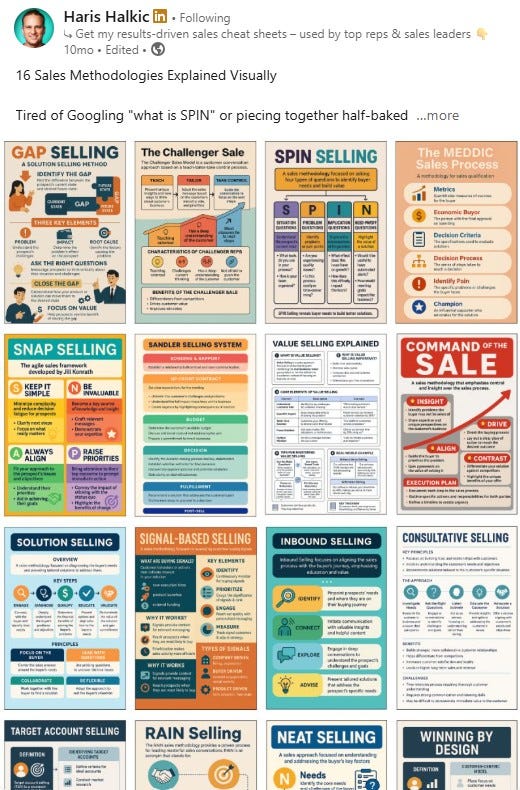
Some are full operating systems. Others are simply discovery checklists with a new acronym.
Let’s be clear: these frameworks are not wrong. They are useful.
But they are incomplete.
Because they mistake an American worldview for neutral reality.
The first thing worth saying - because Sales teams often forget it - is that these frameworks are not scripture. They are tools. They exist to give Reps structure when reality is messy.
They help you avoid improvising blindly, especially early in your career, when structure can temporarily substitute for confidence.
But they are not a substitute for judgment.
And the moment a team starts treating a framework like a religion, something predictable happens: structure replaces skill.
That is how you end up in Sales Kickoffs where performance replaces thinking. The most famous example is probably Steve Ballmer on stage at Microsoft, jumping and shouting for minutes, trying to inject energy into the room.
I have watched that video more times than I can count over my career. And I can tell you something simple. At no point did it speak to me. At no point did I relate to it. I did not even understand what I was supposed to feel.
That is not a critique of Ballmer.
It is a cultural tell.
Because Sales methodologies do not only teach you how to sell.
They also teach you how to think.
The easiest way to make sense of the ocean of frameworks is to stop calling everything a methodology.
In practice, they fall into a few categories:
Discovery frameworks (SPIN, SPICED, GPCT) help Reps structure conversations.
Qualification frameworks (BANT, MEDDICC, NEAT) help them decide whether a deal is real.
Persuasion and positioning frameworks (Challenger, Gap Selling) help them shape how buyers think.
And then there are full Sales operating systems (Sandler, Miller Heiman, Solution Selling) that try to govern the entire cycle - from first contact to expansion.
I once saw a post on LinkedIn listing twenty methodologies and concluding: “Pick one and master it.”
It is good advice if your goal is compliance. A terrible one if your goal is craft.
The best Reps I have worked with did not treat Sales frameworks as religions. They treated them as tools. They learned as many as possible, not to follow them blindly, but to recognize patterns, borrow what works, and adapt in real time.
In complex deals, you rarely lose because you used the wrong acronym.
In fact, I learned that lesson early, in a very different context.
Years ago, I sold books door to door in the U.S. After a week of intense training, we were loaded with scripts, pitches, and “perfect” sequences. The best advice I received was disarmingly simple:
“If you forget your pitch, it’s fine. Mrs. Johns doesn’t know it either. Just keep it flowing.”
You lose deals when you cannot adjust your approach when the situation changes.
At some point, you start to wonder if you are looking at a diverse ecosystem of ideas…
Or just different skins on the same operating system.
Because there is a deeper reason why so many methodologies feel incomplete. And it is rarely discussed.
Most of what we call “modern Sales best practice” is not universal.
It is American.
The part nobody says out loud
Almost every major Sales methodology taught today was created in the United States.
That alone is not a problem.
The U.S. has the largest economy, the most influential business schools, and the biggest market for Sales training and consulting. It makes sense that the frameworks would be produced there, codified there, and exported from there.
It also helps that the business language of the modern world is English. Ideas travel faster when they are born in the language everyone already uses - and even faster when they can be reduced to a four-letter acronym that looks good on a slide.
I remember a moment that made this painfully obvious.
A few months into a U.S.-based company, I attended a Sales Kickoff in Las Vegas. An afternoon session was run by top-tier consultants, with the executive team on stage, and hundreds of Reps in the room. At some point, the consultant asked a question meant to teach “strong Sales posture”:
“How long can your customer make you wait before you take your bag and leave?”
The executives answered without hesitation.
“Five minutes.”
“Ten minutes, max.”
And I remember sitting there, newly hired, based in Dubai, thinking: this is not a Sales principle. This is a cultural assumption.
So I raised my hand.
In my region, I said, meetings often start 15 to 30 minutes late. Sometimes they are postponed at the last minute. And yet deals still get signed. Big ones.
The consultant smiled and added, almost as an afterthought:
“Of course, you need to take local culture into consideration.”
Exactly.
That one sentence - delivered as a footnote - is the entire point of this article.
The problem is what happened next.
We started treating American business culture as if it were a neutral baseline.

As if it were simply “how business works.” But Sales methodologies are not neutral.
They are theories of human organization.
They carry assumptions about how trust is built, how disagreement is handled, how decisions are made, what credibility looks like, and how fast a deal should move.
And on most of those dimensions, American business culture is not the global average.
It is an extreme.
And because of American soft power, it is an extreme that has been exported as a standard.
There is a simpler way to see how deep this American default runs.
A while back, I wrote an article about Sales stereotypes in movies.
And almost without trying, I ended up with the same conclusion.
The most influential “Sales movies” people reference are overwhelmingly American: Glengarry Glen Ross, The Wolf of Wall Street, Boiler Room, Jerry Maguire, The Pursuit of Happyness.
The slick, aggressive closer - the fast-talking white guy in a suit who weaponizes pressure - is not a universal Sales archetype.
It is an American cultural export that became global shorthand.
And once a culture exports the stereotype, it usually exports the playbook too.
Which, honestly, is Sales 101.
Sales methodology is culture, disguised as process
This is where Erin Meyer’s framework in The Culture Map becomes useful.
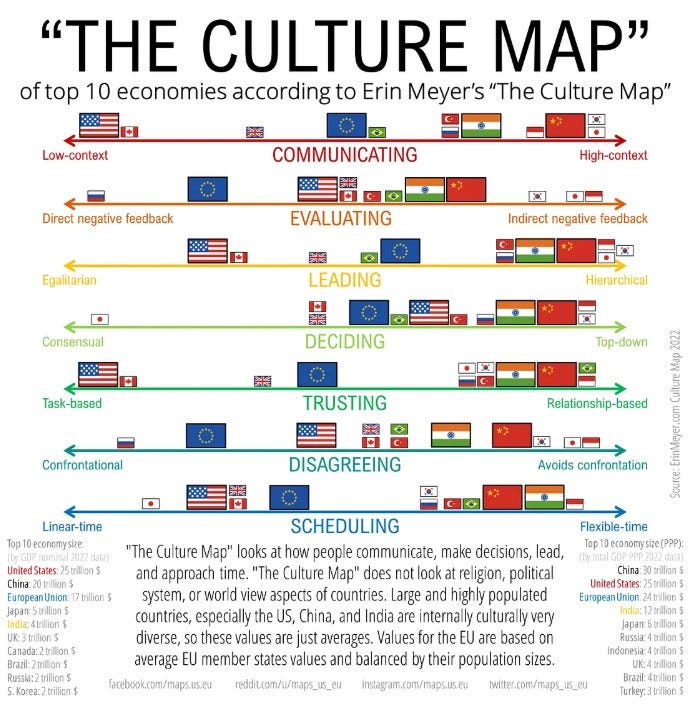
Not because it “explains Asia.”
But because it makes something visible that Sales literature rarely admits:
Selling is a cultural act before it is a methodological act.
Meyer describes eight cultural dimensions. And they map onto Sales almost too well:
Communicating (low-context vs high-context)
Evaluating (direct negative feedback vs indirect)
Persuading (principles-first vs applications-first)
Leading (egalitarian vs hierarchical)
Deciding (consensual vs top-down)
Trusting (task-based vs relationship-based)
Disagreeing (confrontational vs avoids confrontation)
Scheduling (linear time vs flexible time)
The point is not that one end is “better.”
The point is that the United States sits, on many of these dimensions, at the extreme end of:
Explicit communication.
Direct feedback.
Task-based trust.
Confrontation as healthy.
Linear time.
Speed as competence.
Now look at the Sales methodologies we treat as universal.
The pattern is almost too clean.
Challenger, MEDDICC, Sandler: American values turned into process
Let’s take three of the most influential frameworks in modern enterprise Sales.
Not to criticize them. But to notice what they assume.
Challenger Sale
Challenger is built around a powerful idea: the Rep creates value by teaching the customer something they did not know, reframing the problem, and leading the buying process with confidence.
But Challenger also assumes a very specific cultural environment.
It assumes that:
communication should be explicit
disagreement is healthy
tension is productive
the Rep has permission to challenge the customer directly
credibility comes from insight, not relationship
speed is a virtue
This maps almost perfectly to American business culture. And it explains why Challenger can feel like a superpower in the U.S.
But in high-context cultures, “constructive tension” often reads as social aggression.
Not productive debate.
Aggression.
And once that line is crossed, the Rep does not lose the deal because the argument was wrong. They lose it because they damaged trust.
MEDDICC
MEDDICC is the gold standard of qualification.
Metrics. Economic buyer. Decision criteria. Decision process. Identify pain. Champion. Competition.
It is clean. It is rigorous. It is measurable.
And it has saved countless Sales teams from wasting time on fantasy pipeline.
But MEDDICC also carries cultural assumptions.
It assumes that:
the buyer has a definable decision process
authority is formal and identifiable
decision criteria can be made explicit
power sits where the org chart says it sits
if you ask the right questions, the truth will surface
documentation is proof
This is not “wrong.” It is simply culturally situated.
In many environments, the decision process is not a process.
It is a political ecosystem.
Decision criteria exist, but they are rarely the real criteria.
The economic buyer exists, but they are often constrained by consensus, relationships, and internal risk. And the most important stakeholders may never appear in a CRM field.
Sandler
Sandler is often misunderstood as aggressive.
In reality, Sandler is closer to a psychological operating system. It teaches Reps to control the process, qualify hard, and avoid being dragged into unpaid consulting.
Upfront contracts. Pain. Budget. Decision. Fulfillment.
Sandler assumes that:
directness is respect
confrontation is clarity
the Rep is allowed to say “no” early
the buyer will respond rationally to boundaries
time should be protected above relationship maintenance
Again: very American.
In relationship-based cultures, this posture can be interpreted as arrogance.
Not confidence.
And the Rep may never get a second chance.
The common thread
These frameworks are different. But they share a worldview.
They assume that:
what matters can be made explicit
truth can be surfaced through questioning
the buyer will reward clarity
disagreement is productive
authority is identifiable
speed is competence
trust is earned through performance
That is not a universal model of human organization.
It is a very American one.
And that is why these methodologies are so powerful - and why they can fail quietly when the cultural operating system changes.
The easy conclusion - and why it is incomplete
At this point, the easy version of this article would be:
“These methodologies work in the U.S., but fail in Japan, China, Korea, or the Middle East.”
That is true. But it is not the real shift.
Because the real shift is not geographic.
It is structural.
It is cultural.
Complex B2B is becoming a “non-American” game everywhere
Even inside American companies, enterprise buying has evolved into something that looks culturally non-American. Not because America has changed. Because enterprise buying has changed.
Buying is no longer an individual act. It is a collective act.
And collective decision-making behaves differently:
It is slower.
It is more political.
It is more relationship-dependent.
It is shaped by internal power dynamics that rarely appear in a CRM.
It is high-context, even when the people involved speak in low-context language.
It is consensus-driven, even when a single person signs the contract.
And it is deeply risk-averse, even when the ROI is obvious.
This is why so many Reps feel like they are “doing everything right” and still losing.
They are executing a playbook designed for a different environment.
A world where:
a single executive could say yes
decisions were faster
buying committees were smaller
internal politics mattered less
and the Rep could “create urgency” without triggering resistance
That world still exists. But it is no longer the default.
The real irony
The irony is that as enterprise buying becomes more committee-driven, relationship-dependent, and politically constrained, it starts to resemble the kind of decision-making that many “non-American” cultures have always had.
High-context cultures have always known that:
the relationship is infrastructure
the decision is social
power is not always formal
disagreement is costly
and forcing speed creates resistance
Which means the skillset that modern enterprise Reps now need is not “new.”
It is simply unfamiliar to Sales literature that was written in a different cultural environment.
What the “non-American” approach offers (without turning it into mysticism)
This is where Eastern philosophy can be useful - carefully.
Not as spirituality. As realism about human systems.
The most practical lessons from relationship-based, high-context cultures have nothing to do with mysticism:
Trust comes before task
In many environments, you do not earn trust by being sharp.
You earn trust by being safe.
And safety is built through consistency, presence, and time.
Consensus takes time
In committee buying, speed is not always a virtue.
Sometimes speed is pressure.
And pressure creates resistance.
Indirect communication is not weakness
In high-context environments, what is not said often matters more than what is said.
The best Reps learn to read the room, not just run discovery.
Harmony matters more than confrontation
The Challenger idea of “constructive tension” can be powerful.
But in many buying environments, tension is not constructive.
It is destabilizing.
And destabilizing the wrong person in a committee is one of the fastest ways to lose a deal quietly.
Long-term orientation changes the game
In many cultures, the question is not “is this the best solution?”
It is “is this the beginning of a long relationship?”
That changes everything about how credibility looks.
Let me give you an example of what this looks like in practice.
A few years ago, I was part of a competitive process. Six partners responded to an RFP. The customer received seven answers total. It was a highly sensitive project.
Too sensitive, it turned out.
When the RFP was supposed to be awarded, we all received the same message:
“The RFP is canceled.”
Three weeks later, we were signing the contract with one of the six partners and the customer - without the RFP ever being reinitiated.
That deal was not won through discovery questions or competitive differentiation.
It was won because the relationship was already infrastructure.
When the formal process became politically impossible, the customer needed a path forward that did not require public justification.
And the only path available was trust.
A methodology-first playbook would call that “luck”.
A relationship-based culture would call it “expected”.
Why your playbook feels like it stops working
If you have ever felt that you were executing your methodology perfectly - and still not moving the deal forward - this is one of the reasons.
You were trying to run a low-context, task-based, direct, urgency-driven process inside a high-context, relationship-based, consensus-driven system.
That mismatch does not always create conflict. Sometimes it creates something worse.
Silence.
We do not need to reject American methodology. We need to recognize its limits.
This is not an anti-American argument.
American Sales methodologies are powerful.
They have produced extraordinary Reps, extraordinary companies, and extraordinary growth.
But they are culturally situated.
And the more global, complex, and committee-driven B2B becomes, the more Sales success starts to look less like methodology mastery - and more like cultural fluency.
In other words:
You do not need fewer frameworks.
You need better judgment about when each framework applies.
And you need to be smart about what those frameworks are really asking of you.
Because every methodology is also an identity. A way of thinking. A way of speaking. A way of seeing the customer.
The more you build your identity outside of those scripts - by paying attention to your environment, your buyers, your reality - the more unique you become.
And in a world where playbooks are everywhere, uniqueness is what makes you hard to replace. Because the future of complex B2B Sales will not be won by the Rep who has memorized the best playbook.
It will be won by the Rep who can read the environment the playbook was never written for.
#B2BSales #EnterpriseSales #SalesLeadership #SalesStrategy #CrossCulturalBusiness
This content is showing the junction of sales methodologies & cultural implicit aspects.
Thank you very much, this post just got you a new subscriber.
Glad to see more "sales content" on Substack.
Really insightful perspective. The point about cultural fluency becoming more important than strict framework adherence in complex B2B really resonates.