
Why do magnets repel?
It sounds like a simple question. Almost a childish one. The kind of question you expect to be answered in a few sentences, with a reassuring analogy and a sense that the world still makes sense.
And yet, this is the very question Richard Feynman famously refused to explain.
I came across it in a video titled Why Do Magnets Work? The One Question Feynman Refused to Explain. I clicked on it expecting a basic refresher, something elementary. Instead, I had to pause. Not because the explanation was complex, but because it was unsettling in the best possible way.
I genuinely learned something.
But what struck me just as much was how obvious the parallel with Sales is.
When Learning Destabilizes You - In a Good Way
I have noticed this pattern before with content from people like Neil deGrasse Tyson. What I enjoy most is not simply learning something new, but having something I took for granted quietly pulled from under my feet. That moment when you realize the question you were asking was the wrong one all along.
I suspect this has a lot to do with the Dunning–Kruger effect. The more you know, the more you realize how much you do not know. Confidence gives way to curiosity. Certainty gives way to better questions.
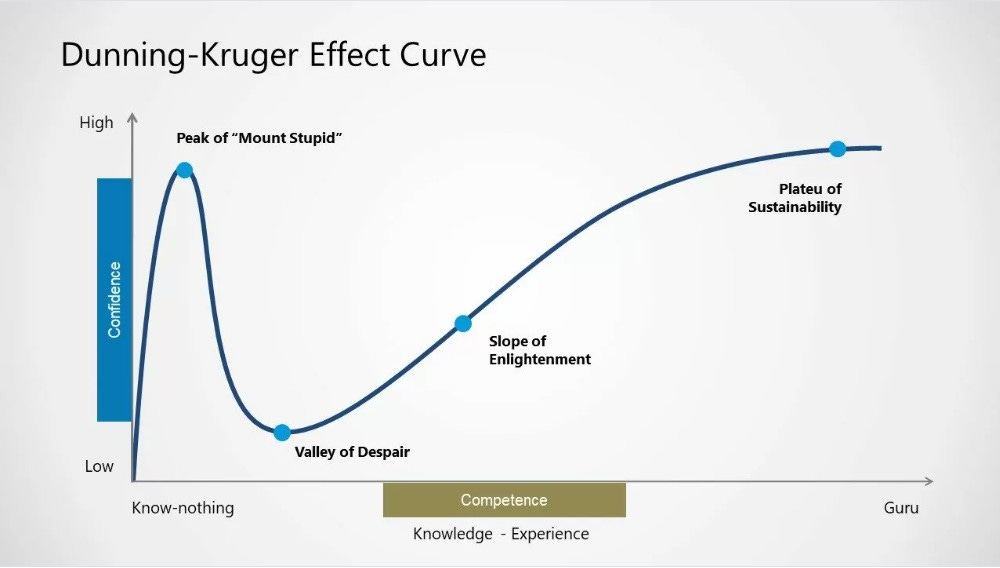
And this, more than anything else, is the advice I believe matters in Sales.
Do not come with your presuppositions.
Do not come with your “I know”.
Stay curious.
Because the moment you stop trying to confirm what you already believe is the moment your discovery calls actually start becoming discoveries.
Why the Question About Magnets Is Broken
The uncomfortable part of the video is not the physics. It is the logic.
When people ask “why do magnets repel?”, what they usually want is not an explanation in the scientific sense. They want a familiar story. Something that connects magnetism to springs, rubber bands, or hands pushing against each other. A narrative that makes the phenomenon feel normal.
But magnetism does not work that way.
Electromagnetism is a fundamental force. There is nothing underneath it to reduce it to. Physics can describe how it behaves with extraordinary precision. It can calculate it, predict it, and use it to build technology.
What it cannot do is make it emotionally comfortable.
And this distinction matters far beyond physics.
Sales Has a Natural Law Too
Here is the Sales equivalent of electromagnetism being fundamental:
Everyone is selling something to someone.
Maybe sad. But true.
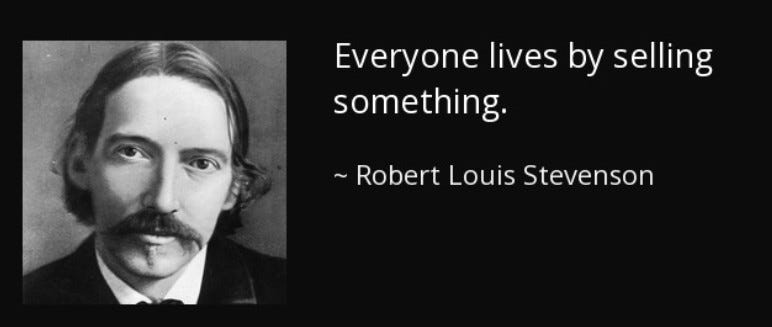
We like to believe selling is a job title. A department. A function reserved for people with “Sales” in their role. But once you look closely, selling is simply persuasion, influence, negotiation, and trade-offs. It is embedded in everyday human interaction.
Even when you are alone, you are selling. One voice argues for the ice cream. Another argues against it. Two positions. One outcome.
Just like magnetism, this is not a metaphor. It is a structural reality of how social systems work.
And just like magnetism, people resist it because it is uncomfortable.
(see : Selling: the elephant in the room, and nobody wants to see it. Including you)
Description Is Not Explanation
In the magnet story, concepts like fields, dipoles, or electron spin sound like explanations. But they are not. They are precise descriptions. They tell you how the force behaves, not why it exists.
Sales does the same thing every day.
“The customer was not ready.”
“Budget got frozen.”
“Procurement blocked it.”
“We lost to politics.”
“No decision.”
These statements can be accurate. But accuracy is not understanding.
They give closure without insight. They reduce discomfort without improving prediction. And they often stop the conversation exactly where it should begin.
Calling something by a name does not explain it. It only makes it feel explained.
Why Magnets Feel Strange - And Sales Feels Mysterious
Magnets repel across empty space. You can see the gap. That is why it feels strange.
But here is the part that matters for Sales: when you push your hand against a desk, nothing is actually touching either. The same electromagnetic force is at work, just across a distance too small to notice.
Sales works the same way.
The forces are always there, but the gaps are invisible:
Between what you say and what they hear
Between a champion and the real decision-makers
Between interest and internal approval
Between a CRM stage and a customer’s reality
We call it “process” because the distance feels small. But nothing is actually in contact.
And when the distance suddenly becomes visible - a stalled deal, a late-stage loss, a “no decision” - it feels mysterious. Unfair. Political.
The mystery is not in the system. It is in our intuition.
Stop Asking “Why”. Start Asking “How”.
Physics does not progress by asking “why does this force exist?”. It progresses by asking “how does it behave?”.
How does it depend on distance?
How strong is it?
Under what conditions does it dominate?
How can we use it?
That is what understanding means: predictive power.
Sales needs the same shift.
“Why did we lose?” is often a comfort-seeking question.
The useful questions are different:
How does influence actually move inside this account?
How is risk distributed, and who is carrying it?
How is status being protected?
How do incentives shape behavior on both sides?
How does resistance accumulate before it becomes visible?
Those questions do not give you neat stories. But they give you leverage.
The Uncomfortable Conclusion
The universe does not owe you explanations that feel intuitive.
Customers do not owe you buying processes that match your CRM.
And people do not owe you decisions that are “rational” by your standards.
Everyone is selling something to someone. All the time.
Once you accept that as bedrock, Sales stops being mysterious. It becomes legible.
Not comfortable. Legible.
And that is where real understanding starts.
#B2BSales #SalesLeadership #SalesDiscovery #InfluenceAndPower #TheB2BSpecialist